The A-File shows that Cresencio first arrived in the United States in 1939. There are a few cursory references to it across various documents, including his petition for naturalization and related paperwork.
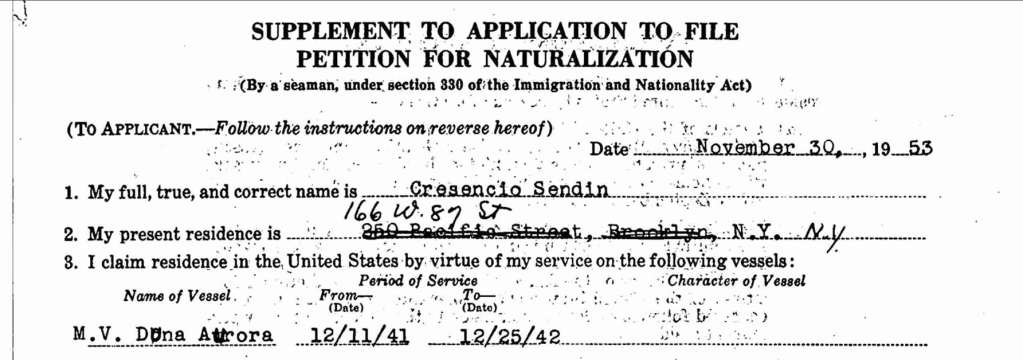
Note the parenthetical: “(by a seaman, under section 330 of the Immigration and Nationality Act.)” This is a specific form, for a specific subgroup, who fall into a specific labor category, and this parenthetical is not incidental. It is, for the bulk of the archive, the named, narrow legal mechanism through which Cresencio’s presence in the United States could be acknowledged at all.
Family memory serves to recall that upon his departure from the Philippines, Cresencio returned briefly to meet with one of his brothers in Manila, and then he went permanently across the world.
His first administratively recorded arrival and stemming presence in the United States was as an oiler on the M.V. Doña Aurora in 1941. He was around 21-22 at the time, deep in the belly of a tanker going from Cape Town to Baltimore. Carrying manganese ore, coffee, wool, and Filipino crew, the Aurora was struck by Italian submarine Enrico Tazzoli on Christmas Day of 1942.
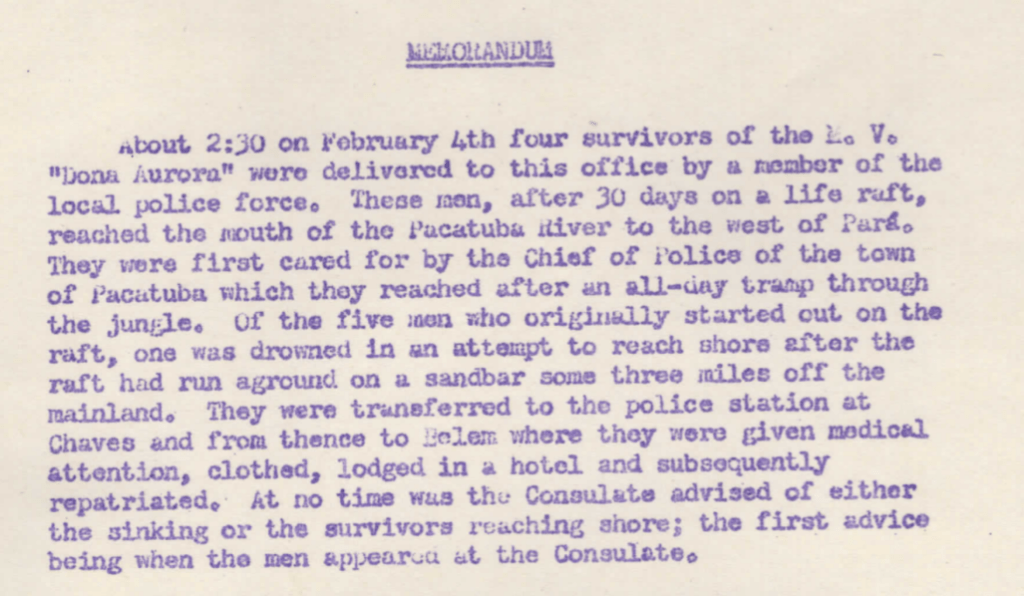
Cresencio jumped as the ship sank, ending up on a liferaft with four other men, one of whom was also Filipino. The ship was swallowed in fifteen minutes. In the immediate aftermath, Cresencio made his way onto a liferaft, with four other men.
They floated for thirty days.
Petitioner and witnesses,
[ ]: “But he couldn’t have been that terrible of a person
if he gave [ ] his address and his picture
and where he would be.”
[ ]: “And [ ] told me and [ ],
‘any time you wanna get in contact with him,
I can give you the address.’”
under oath reaffirmed
their testimonies and affidavit
given at the prel minary interrogation.


Leave a Reply